
Behavior always tells a story.
If you told my younger self that I’d become a veterinarian, I probably would’ve laughed. I didn’t start out pre-vet, or even in biology. I actually began my college journey at Western Michigan University as a mechanical engineering major.
I’ve always been drawn to problem-solving — the kind of kid who took things apart just to see how they worked (sorry, Mom). Engineering made sense. I was confident in math and science, and by my third year, I was nearly finished with the program — already moving into my final stretch before graduation.
Then, one semester, I needed an elective. I signed up for Introduction to Psychology.
The Class That Changed Everything
It only took about a week for me to realize I was hooked.
I found myself completely fascinated by the “why” behind people — why we think the way we do, how we make decisions, how experiences shape us, and how environment and reinforcement influence behavior. I started learning about Pavlov’s conditioning, Maslow’s hierarchy of needs, and the link between thought and emotion.
For the first time, science didn’t just explain the physical world — it explained the human one.
So naturally, I took another psychology class. Then another.
Before long, I had to have a big conversation with my then-girlfriend (now my wife, Brittany).
I told her, “I think I’m going to switch majors.”
I’ll never forget the look on her face. She stared at me like I’d just said I was dropping out to join the circus.
Let’s just say she was concerned.
“Jason,” she said, “you’re not exactly known for being… uh… opinionated about people problems.”
(She wasn’t wrong.)
But I stayed the course. I switched majors, stuck with it, and graduated from Western Michigan University with a degree in Psychology. I planned to pursue clinical psychology and had already received acceptance letters to graduate school when life — as it often does — surprised me again.
The Moment Everything Made Sense
One night, I was sitting at home going through graduate school paperwork, and Animal Planet was playing in the background.
I don’t remember the exact show, but I remember the moment perfectly. A veterinarian was helping an injured animal, explaining both the medical condition and the emotional stress the animal was feeling.
It hit me like a freight train.
This was it. This was the bridge between everything I loved — science, psychology, animals, and people.
That night, I realized my true calling wasn’t psychology instead of veterinary medicine — it was veterinary medicine because of psychology.
Everything suddenly made sense.
A Childhood Dream Revisited
Not long after I made my decision, my mom brought me something I’d completely forgotten about — an old paper I wrote in 5th grade.
In that paper, my 11-year-old self wrote that my dream was to “work with pets to heal them and save them.”
Somewhere along the way, I’d pushed that dream aside for something more “practical” — a career that made sense, that paid well, that felt safe and predictable. I thought that’s what I was supposed to do.
But that old paper reminded me that sometimes your heart knows the truth long before your mind catches up.
My fifth-grade self already knew exactly where I was meant to end up.
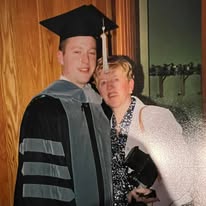
My mom has since passed away, but I still think about that day often — her standing there, holding that paper and smiling. I know she’s looking down on me now, watching me live out the dream that 11-year-old me put on paper all those years ago. Every time I practice medicine, I feel her with me — proud, steady, and reminding me that purpose is worth following, even when the path changes.
How Psychology Shapes My Practice Today
Now, decades later, I use my psychology degree every single day.
🐾 In the exam room, psychology helps me read both people and pets. I can see when a dog is nervous before they show it, or when a client feels anxious. Understanding behavior helps me slow down, listen more, and create trust.
🐕 With patients, behavioral psychology reminds me that fear is a biological response, not “bad behavior.” A growling dog isn’t defiant — he’s scared. A cat who hides under the chair isn’t stubborn — she’s overwhelmed.
That understanding is why I’m such a believer in Fear Free care. It’s not just a trend — it’s based in neuroscience. When pets feel safe, their brain chemistry changes. Stress hormones drop. They learn faster, heal faster, and trust more deeply.
👩⚕️ With my team, psychology has taught me that the same principles apply to people. We all want to feel safe, heard, and valued. Leadership isn’t about giving orders — it’s about understanding motivation and emotion.
Why Fear Free Matters
Fear Free medicine means that we care for the whole patient — body and mind. It means we pay attention to how our patients feel, not just what they weigh or how their labs look.
When a pet walks in the door, we don’t just see their diagnosis — we see their story. Their fears, their habits, their trust.
By reducing stress, we make every visit safer and kinder — for the pet, the client, and the entire team.
The Lesson That Stuck
Psychology taught me something I carry into every single day of my work:
Behavior always tells a story.
Whether it’s a trembling puppy, a frustrated client, or a stressed-out team member — behavior is just communication we haven’t translated yet.
And that’s why I practice the way I do — with patience, empathy, and an understanding that healing doesn’t always start with medicine. Sometimes, it starts with listening.
– Dr. Jason Harrison, DVM
Tawas Animal Hospital
